
A room that feels comfortable while you lace up your shoes can feel quite different halfway through a workout. Yet repeatedly lowering the temperature can leave you standing in an icy draught when you pause between sets. Effective home gym cooling needs to account for how you move, where you exercise and how the room feels once you stop.
In a Central Coast home, choosing the right cooling arrangement involves more than selecting a temperature on the controller. Equipment placement, exercise intensity, humidity and ventilation all influence how comfortable the space feels. All Coast Air Conditioning helps homeowners consider these factors when planning a suitable cooling solution. Knowing what affects your workout environment also makes it easier to compare installation recommendations based on your actual needs.
Why Exercise Changes the Cooling Experience
Exercise changes how you experience a room, even when the controller setting stays the same. Your activity level, the number of people exercising and the length of each session all influence what feels comfortable.
Unlike a lounge where occupants spend most of their time sitting, a home gym involves different movements, positions and levels of physical exertion. The aim is to provide effective cooling without creating uncomfortable air streams across your usual workout areas.
Activity Levels Change How a Room Feels
Your cooling preferences can shift several times during one session. You might start with gentle movement, spend time on more demanding exercises and finish with stretching. A setting that feels comfortable during the busiest part of your workout may feel too cold when you lie still on a mat.
These changes do not necessarily indicate that the air conditioner is performing poorly. Room temperature and personal comfort are not the same thing. Before making a significant adjustment, consider whether your activity level has changed, you have moved closer to an outlet, or you have stopped exercising directly beneath the airflow. The Australian Government’s YourHome guide explains the factors that influence thermal comfort, including temperature, humidity and air movement.
Occupancy matters too. Two people exercising together introduce a different heat and moisture load than one person using the room briefly. Powered equipment, including treadmills and exercise bikes, can also generate heat during extended use. Combined with occupants and sunlight entering through windows, these factors can influence the room's cooling requirements.
Session length adds another consideration. A short workout in a room that has been closed all afternoon starts under different conditions from a longer session in a space already used throughout the day.
A Workout Space Has Different Comfort Needs From a Lounge
In a lounge, your usual position might be a chair several metres from an outlet. In a gym, you could alternate between standing, sitting on equipment and exercising close to the floor. Each position can expose you to a different part of the airstream.
This is most important in a multipurpose room. If your gym also serves as a study or spare room, the cooling arrangement should remain comfortable during quieter activities. Designing everything around the most demanding part of a workout can make the space less pleasant for the rest of the day.
Local conditions also affect the starting point. Afternoon sun, a warm roof space and humid weather can change how the room feels before you begin exercising. Understanding how the Central Coast climate shapes your cooling needs helps put these differences into context without assuming every workout requires the same temperature setting.
Where Should I Position Equipment to Avoid Direct Drafts?
The relationship between your exercise equipment and the cooling outlet can matter as much as the temperature setting. A room can feel comfortable overall while having one unpleasant spot where the strongest airflow lands.
Before settling on a layout, identify where you spend the most time during exercise. Your treadmill, bench and floor mat deserve attention because you may remain in those positions for several minutes at a time.
Keep the Main Workout Position Out of the Strongest Air Stream
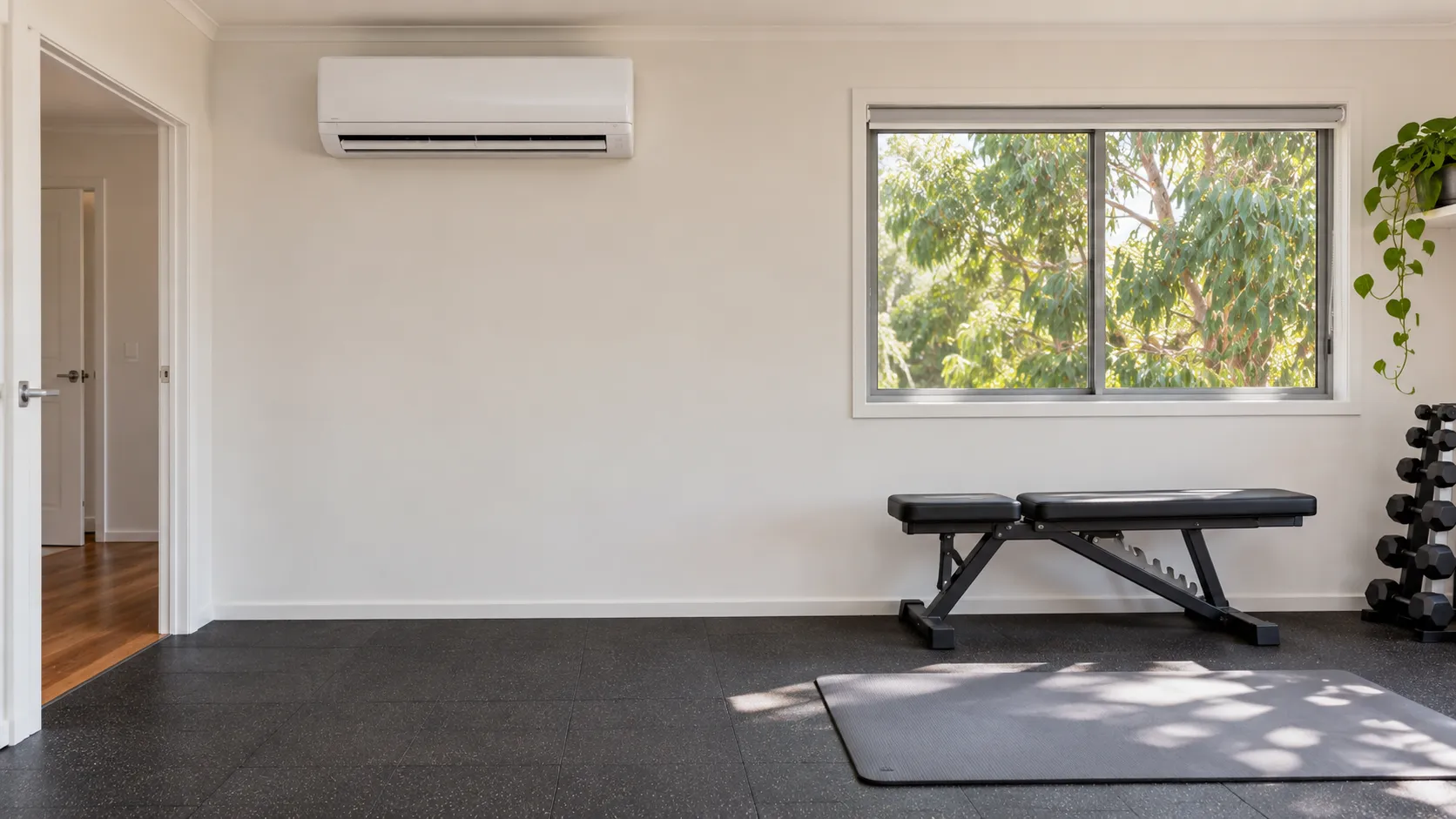
Notice where the air travels during normal operation, using only the user controls described in the manufacturer's instructions. Consider whether it reaches your face, neck or torso while you are in your usual exercise position. Airflow that passes comfortably above you while standing may land directly on you when you sit down.
Where practical, position movable equipment outside the strongest airstream. A modest change to the location of a mat or bench may be more useful than lowering the temperature across the entire room. Keep the equipment's required operating clearances and safe access in mind rather than squeezing it into an unsuitable position purely to avoid a draught.
Adjustable louvres may offer another option where the manufacturer permits user adjustment. Their purpose is to help distribute air throughout the room, not necessarily direct the coldest airflow towards your workout position. Use the supplied controls rather than forcing louvres by hand or attaching makeshift deflectors.
If your preferred equipment layout places you directly in the discharge path, explain that constraint to an installer. Moving or altering an air conditioning unit, outlet or ductwork is work for a licensed professional.
Leave Space for Air to Circulate Around Bulky Equipment
Large equipment and storage can interrupt circulation. A tall rack, stacked mats or a cabinet placed near an outlet may divert the air before it reaches the occupied part of the room. Blocking a return-air grille can also interfere with the system's intended airflow.
Keep supply outlets and return-air paths unobstructed, following the system's instructions and any installer advice. Required clearances depend on the equipment and installation, so do not assume that a gap which looks adequate suits every system.
Think about the room in use, not just when it is tidy. A folded machine may sit clear of the airflow but obstruct it when opened. Doors, movable benches and equipment stored between sessions can also change how air travels through the space.
When comparing proposed installations, ask the installer to explain how air will circulate with your equipment in place. A marked floor plan or clear photographs can identify potential airflow problems before the installation position is finalised.
How Should I Run the Cooling Before and During Exercise?
Cooling is easier to manage when you give the room time to become comfortable and make measured adjustments during your session. Repeatedly selecting a much lower temperature can create a setting that no longer suits you once your activity slows.
There is no universal ideal temperature for every workout or household. Your practical aim is to maintain a comfortable environment with well-distributed airflow, using the operating options available on your particular system.
Allow Time for the Room to Become Comfortable
If the gym has been closed up and feels warm, start the cooling before you begin exercising. The required lead time depends on the room, weather and system, so avoid treating a fixed number of minutes as a rule. Pay attention to how the space responds under your usual conditions.
Where a timer or scheduling function is available, prepare the room for a regular session. Check that the schedule still suits your routine, especially if workout times change. Cooling an unused room because of an outdated timer setting serves little purpose.
Choose a reasonable starting temperature rather than the lowest available setting. On many systems, selecting an extreme temperature does not make the initial cooling happen faster. It mainly asks the system to continue cooling towards a lower target, which may become uncomfortable later.
If your gym shares a ducted system with other rooms, consider the approved zoning arrangement and the needs of other occupants. Avoid changing outlet positions or closing multiple outlets to force more air into the gym. Ask the installer how the system is intended to operate with different zones selected.
Adjust Airflow Rather Than Continually Lowering the Temperature
When the room is reasonably cool but you still feel uncomfortable, consider the airflow before changing the temperature again. A manufacturer-approved fan setting or louvre adjustment may improve air distribution without making the entire space colder.
Higher fan speed is not automatically better. It may move air more noticeably but also create a stronger draught or additional noise. Automatic fan operation can be useful on some systems, although its behaviour varies. Try the available user settings and assess comfort from your normal exercise positions.
For a gym served by an inverter ducted system, understanding how inverter technology responds to changing demand can explain why output changes during a session. Variable output does not remove the need for suitable airflow placement.
As you move into quieter exercises, reassess the setting. A small adjustment may be enough. If the room repeatedly swings between stuffy and uncomfortably cold despite normal operation, describe that pattern to a qualified technician rather than compensating with increasingly extreme settings.
Cooling and Fresh Air Solve Different Problems
A home gym can feel cool without receiving enough fresh-air exchange for how you use it. Cooling and ventilation perform different jobs, so lowering the controller setting is not an answer to every type of discomfort.
For an exercise space, the important distinction is between removing heat and replacing indoor air. Knowing which problem you are experiencing helps you ask more useful questions when seeking advice.
Recirculated Cool Air Is Not a Fresh-Air Supply
Many residential air conditioners mainly recirculate indoor air. Unless your installation has a specific outdoor-air provision, you should not assume that air coming from an outlet is fresh air from outside. A split system's outdoor unit does not, by itself, mean outdoor air is being supplied to the room.
This matters if you close the gym door for noise or privacy during a workout. The room may reach the selected temperature while still feeling stale. Lowering the temperature further addresses heat, not an underlying lack of air exchange.
An open door to another indoor room may change circulation, but it does not establish that fresh outdoor air is reaching the gym. Likewise, stronger fan operation within a recirculating system moves air around without necessarily replacing it.
The ventilation arrangement needs to account for the room, number of occupants and how long the space is used. Depending on the property, this may involve suitable natural ventilation or a separately designed mechanical ventilation solution. The Australian Government’s YourHome guide explains how ventilation supports indoor air quality by introducing outdoor air to dilute and displace indoor pollutants.
Tell your installer if you normally exercise with doors and windows closed. If you rely on opening a window between sessions, explain that too. Outdoor heat and humidity can affect how useful that approach is at a particular time, while open windows can increase the cooling load when the system is running. The suitable arrangement depends on the room rather than a universal instruction to leave everything open or shut.
Moisture and Stale Air Need Separate Consideration
Exercise can add moisture to a room through perspiration and breathing, when more than one person is exercising. Cooling can remove some moisture during normal operation, but this does not make an air conditioner a substitute for ventilation or guarantee a specific humidity level.
Humidity can also affect how comfortable a workout feels. When moisture levels are elevated, perspiration may evaporate less efficiently, making the room feel warmer or more uncomfortable even when the temperature seems reasonable.
Notice when the problem occurs. Does the room feel stale only after a longer session? Do windows show persistent condensation? Does the space remain damp after everyone has left? These observations are more useful than simply reporting that the gym needs to be colder.
Avoid assuming that a dry mode, where fitted, resolves every moisture concern. Its operation depends on the system and surrounding conditions, and it may change the room temperature as well. Follow the manufacturer's instructions.
Persistent dampness, unusual odours or visible condensation deserve professional assessment rather than repeated temperature adjustments. These symptoms may indicate a ventilation, moisture-management or building issue that must be investigated separately from cooling performance.
What Should I Explain to an Installer About My Workouts?
An installer can give more relevant advice when you describe how the gym actually operates. Room dimensions matter, but they do not explain where you stand, how long you exercise or why one corner feels uncomfortable.
Bring the discussion back to your routine and the room's other uses. This gives you a clearer basis for comparing local suppliers than asking each one to recommend a system based on floor area alone.
Describe the Number of Users and Typical Session Length
Explain if you usually exercise alone or with someone else, and if sessions are brief, extended or highly variable. Describe the activities in everyday terms. Alternating between a treadmill and floor exercises tells an installer more about changing comfort needs than simply calling the room a gym.
Mention the time of day you normally train and if the room has been occupied beforehand. An early session in a cool room presents different starting conditions from an afternoon workout after hours of direct sunlight.
You do not need to calculate a cooling capacity yourself. Instead, provide accurate information about windows, shading, equipment and occupancy, then let a licensed professional assess the installation requirements.
If your search for air conditioning in Central Coast has reached the quoting stage, give experts the same practical brief you use when comparing recommendations. Explain whether you need advice on an existing setup or are planning an installation, and make avoiding direct draughts an explicit priority.
Show the Equipment Layout and Normal Room Use
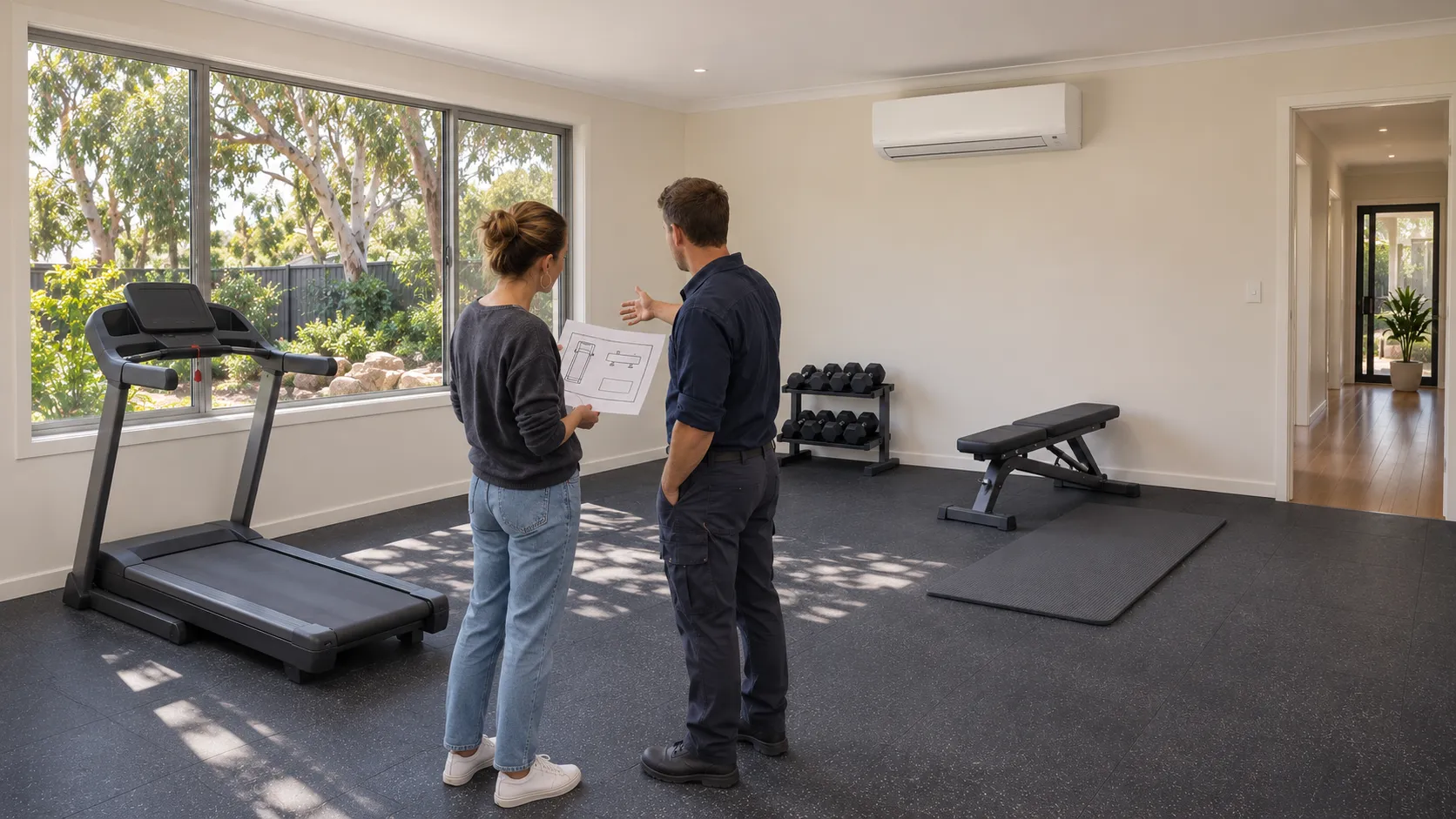
Provide a simple sketch or photographs showing the main workout positions, bulky equipment and storage. Mark where you lie on a mat as well as where you stand. If equipment folds out or moves during exercise, show both arrangements.
Identify existing outlets and controls without removing covers or accessing equipment. Explain any comfort issues in specific terms, such as a cold stream across the bench or uneven cooling between the mat and treadmill. Also mention if doors are normally closed during exercise.
Include quieter uses of the room. If someone works at a desk there or uses it as a spare bedroom, the proposed airflow needs to accommodate those positions too. Ask how the recommended controls would support both active exercise and less active use.
For any proposed installation or alteration, ask the supplier to explain the outlet location, expected air direction and normal operating settings. A useful recommendation should connect those choices to your layout and routine, with electrical, refrigerant and other installation work handled by appropriately licensed professionals.
Create a More Comfortable Home Gym With the Right Cooling Setup
A comfortable home gym needs more than a low temperature setting. Equipment placement, exercise intensity, room occupancy, humidity and ventilation all influence how the space feels throughout a workout. Addressing these factors together helps prevent uncomfortable draughts, uneven cooling and stale indoor air.
Before choosing a system or changing an existing installation, consider how you use the room throughout the day and what you expect from your cooling arrangement. All Coast Air Conditioning helps homeowners assess their home cooling requirements and explore suitable air conditioning options. Discuss your workout routine, equipment layout and comfort concerns to find a proper approach.
We Run Our Business Like a Family
When You Need Help
Get your home the Air Conditioning work it needs from our team at All Coast Air Conditioning. We’re always ready to help.


